

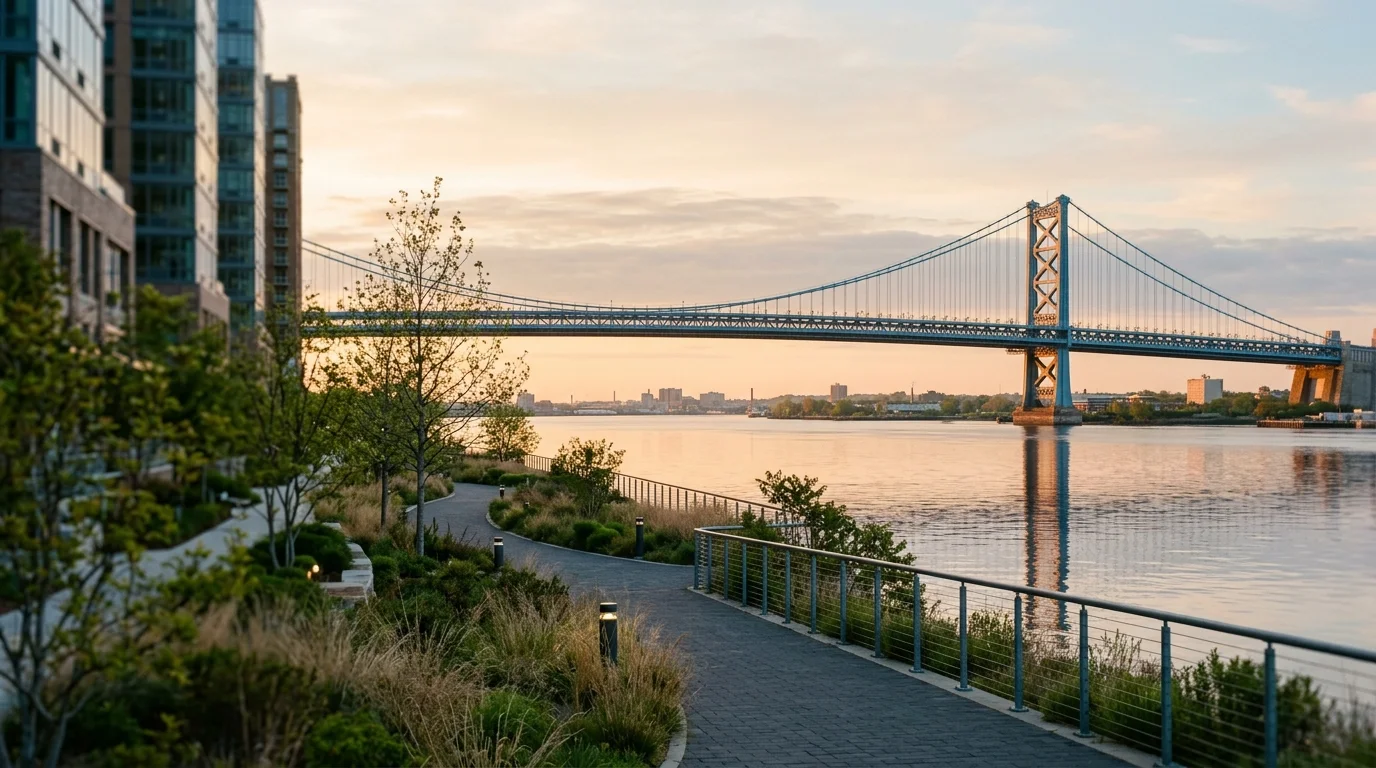
Waterfront Square is a gated condominium community of three towers, the Reef, the Regatta and the Peninsula, on the Delaware River at 901 N. Penn Street, between Northern Liberties, Fishtown and Old City. Living there means river and skyline views, a full set of on-site amenities and quick access to I-95, but the experience of any one unit depends on its tower, floor, exposure, layout, parking and the building’s finances, so no two purchases are the same. Naomi has closed more than 30 sales and leases at Waterfront Square since 2018, according to Bright MLS records as of September 2026.
I know Waterfront Square inside and out. I have sold units there, and I have seen how differently two apartments in the same building can live. This guide is what I tell people before they tour: where the complex sits and how you get around from it, what the association itself says it offers, how units differ from each other, and the questions you need answered before you sign anything. It also covers the other side of the table, because if you already own at Waterfront Square, the question is how your unit stands against every other one for sale in the same complex.
One rule runs through the whole page. Condo fees, pet rules, rental rules, reserves, special assessments and parking arrangements change. A number that was right last year may be wrong today, which is why you will not find them here. Ask me for the current answers and I will get them for the specific unit you are looking at.
Where Waterfront Square is, and how you get around
The address is 901 N. Penn Street, Philadelphia, PA 19123. The Philadelphia Inquirer places the complex at Columbus Boulevard and Spring Garden Street, right on the Delaware River. The association describes it as a gated, 9.5 acre riverfront enclave positioned near Northern Liberties, Fishtown and Old City, and close to I-95, the Ben Franklin Bridge and I-676.
For the practical questions, here is what I can point to on a map:
| Getting to | How | What to know |
|---|---|---|
| Center City by rail | SEPTA Market-Frankford Line (L1) from Spring Garden station, on Spring Garden Street between 2nd and Front Streets | About a third of a mile in a straight line west of the complex, measured on City and SEPTA map coordinates. The line runs through Old City and Center City |
| 30th Street Station | The L1 continues west to the stop SEPTA lists as Drexel Station at 30th St. The association also describes a weekday resident shuttle to several Center City stops and 30th Street Station | Shuttle schedules are set by the association and can change. Ask for the current schedule |
| Local buses | SEPTA Route 43 stops at Columbus Boulevard and Spring Garden Street and runs west along Spring Garden Street. Route 25 serves Columbus Boulevard and Delaware Avenue | Check SEPTA for current routes and schedules before you rely on them |
| The airport and out of town | By car via I-95, which the association lists among its nearby highways, along with the Ben Franklin Bridge to New Jersey and I-676 | If you travel often, drive the route at the hour you usually leave before you commit |
| The river on foot or by bike | The Delaware River Trail, which the association says is right outside its door | The Delaware River Waterfront Corporation reports the trail runs 3.3 miles from Pier 70 in South Philadelphia to Penn Treaty Park in Fishtown |
That last row is the one my Waterfront Square buyers mention most after they move in. The Delaware River Waterfront Corporation reports that a major section of the trail between Washington Avenue and Spring Garden Street was completed in spring 2022, with a curb-separated bike path and a separate sidewalk for walking and running. North, it reaches Penn Treaty Park. South, it passes Race Street Pier, Cherry Street Pier and Spruce Street Harbor Park. If your idea of a good morning is a walk along the river before work, this is one of the places in Philadelphia where you can do that from your front gate.
If you are weighing Waterfront Square against the rowhomes and lofts nearby, my guides to Northern Liberties and Fishtown and to Old City and the Delaware River waterfront cover the surrounding housing, streets and landmarks.
The three towers
According to the association, Waterfront Square is made up of three towers, the Reef, the Regatta and the Peninsula, with 484 units ranging from one to three bedrooms. It was not always meant to stop at three. The Inquirer reported in 2013 that the project was planned as five residential towers, and the two that would have completed the plan were never built as condominiums.
The Reef is the newest. The Inquirer reported that the Regatta and the Peninsula were completed during the housing boom and that the Reef’s completion was delayed until April 2009. It described the Reef as a 22-story tower with 179 units. City of Philadelphia property records list 2009 as the year built for that tower’s units. The Regatta and the Peninsula date from the middle of the 2000s. Published completion years for those two differ between sources, and I would rather tell you that than print a year I cannot stand behind.
The design of the site matters to how it lives. The association says the complex was designed by Wallace Roberts & Todd and that the towers are arranged around a landscaped park built as a green roof, which also provides walking and recreational space for residents. In practice, that means your view, your light and even your walk to the garage depend on which tower you are in and which side of it faces the park, the river or the city.
Why the tower matters before the unit
- Each tower has its own age, its own systems and its own lobby. A unit in the newest tower and a unit in one of the two older towers can carry different maintenance histories.
- Floor plans, balcony depth and window lines differ by tower and by stack. A layout that works in one tower may not exist in another.
- Your view is set by the tower and the exposure: some units face the river and the Ben Franklin Bridge, some face the Center City skyline, some face the grounds.
- Buyers comparing sold prices should compare within the same tower and, where they can, the same stack and similar floor, rather than across the whole complex.
What the association says it offers, and what residents actually use
Here is the amenity list in the association’s own categories, as its website describes it today. Amenities, providers and hours change, so treat this as a starting point to confirm, not a promise.
| Category | What the association describes |
|---|---|
| Arrival and security | Gated entry staffed around the clock, and a front desk concierge that accepts package deliveries. Valet dry cleaning is also listed |
| Pool and deck | A 25-meter pool in a glass-enclosed atrium, with sliding doors that open to a riverfront deck in warmer months, plus a Jacuzzi, steam room and sauna |
| Fitness | A 12,000-square-foot fitness facility with cardio and strength equipment and river views, group classes, personal training and on-site massage by appointment |
| Parking and getting around | A covered parking garage, EV charging stations, a weekday resident shuttle to Center City stops and 30th Street Station, and an Indego bike share station near the front gate |
| Grounds | Landscaped gardens, riverwalk trails, a green roof with a putting green, and two dog parks |
| Community spaces | A community room off the lobby in each tower, which residents can reserve for private functions, and resident events through the year |
A list like that looks the same in every brochure. What I share with buyers is how it plays out day to day: which amenities people actually use and which mostly look good in photographs, which lobby you would come home through, how far your elevator bank is from the garage, and what a weekday morning looks like at the gate. That is the part you cannot learn online, and it is the part that decides whether a unit fits your life.
A few questions I ask every Waterfront Square buyer early, because they sort units faster than square footage does:
- Can you walk along the river in the morning, and does that matter to you?
- How often do you go to 30th Street Station or the airport, and at what time of day?
- Where will your guests park when they visit?
- If you have a dog, where will you walk it, and what are the current pet rules for that tower?
- Will this still feel right three years from now?
Two units in the same building can be completely different
This is the single biggest misunderstanding I see with Waterfront Square. People assume that because the address is the same, the units are interchangeable, and that a price per square foot from one sale tells you what another unit is worth. It does not. Two condos in the same building can offer completely different experiences, and different values, depending on:
| Factor | Why it changes the unit | How to check it |
|---|---|---|
| Tower | Age, systems, lobby, elevator banks and distance to parking differ by tower | Confirm the tower on the listing and in the resale certificate |
| Floor | Higher floors change the view and the light, and sometimes the noise from the street and highway | Visit at different times of day |
| Exposure and view | River and bridge, skyline, or grounds. Morning sun versus afternoon sun | Stand at the windows, and check what could change in the view |
| Layout | Split bedrooms, a usable dining area and closet space affect how a unit lives and resells | Get the floor plan and measure what matters to you |
| Balcony | Size and orientation vary, and so does how usable it is | Step out on it, and ask about any balcony repair history |
| Parking | How the space is conveyed and where it sits in the garage | Confirm in writing what transfers with the unit |
| Fees | Assessments are allocated unit by unit under the declaration, so they vary by unit | Read the current figure in the resale certificate |
| Building systems | Heating and cooling equipment, windows and plumbing differ by tower and by age | Ask for the unit’s system type and service history, and inspect |
| Condition | Original finishes versus renovated kitchens and baths | Compare against recent sales of similar units, not the complex average |
When I pull sales for a Waterfront Square buyer, I compare like with like: same tower, similar stack, similar floor and exposure, similar condition. A skyline-facing one bedroom on a low floor and a river-facing two bedroom near the top are different products that happen to share a street address.
Looking at a unit at Waterfront Square?
Tell me the tower and unit number and I will get you the current fees, rules, parking arrangement and recent comparable sales in that tower.
Ask NaomiWhat to ask before you buy at Waterfront Square
Pennsylvania gives condo buyers a real tool here. Under the Uniform Condominium Act, 68 Pa.C.S. 3407, a seller who is reselling a unit must give the buyer copies of the declaration, the bylaws, the rules and regulations and a resale certificate. The association must produce the certificate within ten days after the owner asks for it. And the buyer can void the purchase contract until the certificate has been provided and for five days afterward, or until settlement, whichever comes first. Use those five days. This is the checklist I work through with every buyer:
Ask Naomi for the current answers
- Fees and what they cover. The monthly common expense assessment for this unit, any other fees, and which services and utilities the fee includes. The certificate must state the assessment and other fees.
- Reserves. The amount of reserves for capital expenditures, and any portion set aside for a specific project. The certificate must state both.
- Planned work. Capital expenditures the association has proposed for the current fiscal year and the next two. The certificate must list them.
- Assessments. Any special assessment currently due, and whether one has been discussed or approved but not yet billed. Read recent board meeting minutes where you can get them.
- Finances and lawsuits. The latest balance sheet, income and expense statement and operating budget, and any judgments or pending suits involving the association.
- Insurance. What the master policy covers and what you need to insure yourself. The certificate must describe coverage provided for the benefit of owners.
- Pet and rental rules. Current restrictions, registrations and any leasing limits, from the rules and regulations and the declaration, not from a listing description.
- Parking type. Whether the space is licensed, assigned, deeded or leased, whether it transfers with this sale, and what it costs.
- Which tower and which exposure. Which tower the unit is in, which way it faces, and what that means for light, views and systems.
- Alterations and violations. Whether the board knows of any alteration to the unit that breaks the declaration, or any violation of governmental requirements. The certificate must answer both.
Flood maps and insurance
Waterfront Square sits directly on the Delaware River. Do not rely on anyone’s word, including mine, about flood risk. Look up the address on the FEMA Flood Map Service Center at msc.fema.gov, the official public source for flood hazard maps under the National Flood Insurance Program, review the association’s master insurance summary, including any flood coverage, and ask your own insurance agent what a unit policy should cover.
Beyond the condo documents, the rest of a Philadelphia purchase still applies: get pre-approved before you seriously shop, understand closing costs including the realty transfer tax, and review the unit’s current taxes, assessed value and any abatement or exemption. My guide to buying a condo or co-op in Center City Philadelphia walks through the condo process in detail, and the payment calculator helps you see how a monthly fee changes what you can comfortably carry.
Inspections deserve a word too. In a high-rise, the inspection covers your unit and its systems, while the association is responsible for the common elements. Knowing where that line falls for this unit, including windows, balcony and heating and cooling equipment, is part of reading the declaration, and I can connect you with inspectors who work in Philadelphia high-rises.
Selling a unit at Waterfront Square: positioning a unit against the rest of the building
If you own at Waterfront Square, your competition is not just the market. It is the other units for sale in the same complex, often in the same tower, sometimes on the same stack. Buyers see all of them side by side, and they will compare yours against every one. Pricing at Waterfront Square is building by building, and inside the complex it is tower by tower and stack by stack.
Price against the right comparables
A neighbor’s sale is not your price. Buyers do not see homes that way. They compare everything available to them at that moment. I look at recent sales and current competition in your tower first, then adjust for floor, exposure, layout, balcony, parking and condition. The goal is to position the unit correctly from the first day, because the first few weeks on the market carry the most attention. When a unit looks overpriced next to three similar listings in the same complex, buyers often do not make a lower offer. They simply move on.
Lead with what makes your unit different
- Views. If you face the river or the bridge, the photography, the video and the showing times should prove it. Sunrise over the Delaware is a selling point you can schedule.
- Layout and light. A floor plan in the listing lets buyers compare your layout honestly against others.
- Updates. A renovated kitchen or bath separates a unit from the original-finish units around it. Document what was done and when.
- Parking. Have the paperwork showing exactly how your space is conveyed and whether it transfers.
Prepare the condo documents before buyers ask
Buyers and their agents will look hard at fees, reserves, assessments, insurance and the rules. Because the association has ten days to produce the resale certificate and the buyer’s five-day window only starts once they receive it, I request it early so it is ready, and I review it with you so there are no surprises in the middle of a contract. If a special assessment is pending or planned, we talk about how to handle it before it becomes an obstacle.
Decide where to spend money, and where not to
I walk through the unit with you and recommend what is worth doing before the photographs, such as paint, cleaning, lighting or staging, and just as importantly what is not. I can connect you with contractors, cleaners and stagers who know the building’s rules for access, elevators and deliveries. My guide to selling a home in Philadelphia covers pricing, costs and estimated proceeds, and you can request a home value estimate here.
If you are selling from out of town, I handle it start to finish, from preparing the unit to coordinating access with the front desk and showing it.
Buying, selling or renting: how I work at Waterfront Square
I am a solo agent with Compass, and I work with buyers, sellers and renters across Philadelphia, in condominiums, rowhomes, twins, single-family homes and co-ops. Waterfront Square is a building I know well, and my past transactions include sales at 901 N. Penn Street. My business started with renters who later became buyers, and I still work with both. You can read more about me in my profile.
My job is not to talk anyone into a unit. It is to make sure you understand the tower, the unit, the documents and the numbers before you decide, and to stay involved through settlement and after.
Frequently asked questions
Waterfront Square is at 901 N. Penn Street, Philadelphia, PA 19123, on the Delaware River waterfront near Spring Garden Street and Columbus Boulevard. The association describes it as a gated riverfront enclave near Northern Liberties, Fishtown and Old City, close to I-95, the Ben Franklin Bridge and I-676. The SEPTA Spring Garden station on the Market-Frankford Line is a short walk west along Spring Garden Street.
Three. The association lists the Reef, the Regatta and the Peninsula, with a total of 484 one to three bedroom units. The project was originally planned as five residential towers, and the remaining two were never built as condominium towers.
The Reef, the newest of the three towers, was completed in April 2009, according to The Philadelphia Inquirer, and City of Philadelphia property records list 2009 as the year built for its units. The Regatta and the Peninsula came first, in the middle of the 2000s. Published completion years for those two towers differ between sources, so confirm the year for a specific tower before relying on it.
Ask for the Pennsylvania resale certificate and read it closely: the current monthly assessment and what it covers, other fees, the reserves for capital expenditures, any capital expenditures proposed for the current and next two fiscal years, pending lawsuits, insurance coverage, and the rules and regulations. Then ask about recent or planned special assessments, pet and rental rules, how the parking space is conveyed, and which tower, floor and exposure the unit has. These answers change over time, so ask Naomi for the current ones.
It depends on the unit and on how the space is conveyed. The association describes a covered parking garage behind a staffed, gated entry, but a buyer should never assume what comes with a particular unit. Confirm in writing whether the space is licensed, assigned, deeded or leased, whether it transfers with the sale, and what it costs. Naomi can verify the current arrangement for any unit you are considering.
Under 68 Pa.C.S. 3407, a seller of a Pennsylvania condominium unit must give the buyer the declaration, bylaws, rules and a certificate covering items such as the monthly common expense assessment, any unpaid or special assessment, other fees, proposed capital expenditures for the current and two following fiscal years, reserves, the latest balance sheet and budget, judgments and pending suits, and insurance. The association must provide it within ten days of the owner’s request, and the buyer may void the contract until the certificate is provided and for five days after, or until settlement, whichever comes first.
Look it up rather than assume. Enter the address on the FEMA Flood Map Service Center at msc.fema.gov to see the current effective flood map for the site, and ask the association for its master insurance summary, including any flood coverage, as part of your due diligence. Then talk to your own insurance agent about coverage for your unit.
Naomi Kurzyna, REALTOR at Compass, works with buyers, sellers and renters at Waterfront Square and across Philadelphia, and her past transactions include sales at 901 N. Penn Street. In her words, “I know Waterfront Square inside and out.” Reach her at (301) 520-3224 or through naomisellsyourhome.com/contact/.
Related resources
Thinking about Waterfront Square?
Whether you are touring your first unit, comparing two in different towers or getting ready to sell, start with a conversation about the specific unit, the current documents and your timing.
Contact NaomiSources
- Waterfront Square Condominium & Spa, official website: About, Pool and Deck, Health and Fitness, Shuttle and Parking, And So Much More, Community and Green Living pages, wfsquare.com
- The Philadelphia Inquirer, “Condo sales back on track at Reef Tower on the Delaware,” Alan J. Heavens, July 2013, inquirer.com
- City of Philadelphia, Office of Property Assessment property records for 901 N. Penn Street, via property.phila.gov and the City’s open data (OpenDataPhilly)
- Pennsylvania Uniform Condominium Act, 68 Pa.C.S. 3407 (resales of units), Pennsylvania General Assembly, legis.state.pa.us
- SEPTA station and stop data for the Market-Frankford Line (L1) and bus Routes 25 and 43, septa.org
- Delaware River Waterfront Corporation, Delaware River Trail, delawareriverwaterfront.com
- FEMA Flood Map Service Center, msc.fema.gov
Building details are as published by the sources above on the dates stated in this guide. Condominium fees, assessments, reserves, insurance, pet and rental rules, parking arrangements, amenities, shuttle service and transit routes change. This guide is general information about living at and buying or selling at Waterfront Square and is not legal, tax, insurance or engineering advice. Confirm anything specific to a unit with the association’s current documents and the appropriate professional.
Social Cookies
Social Cookies are used to enable you to share pages and content you find interesting throughout the website through third-party social networking or other websites (including, potentially for advertising purposes related to social networking).