

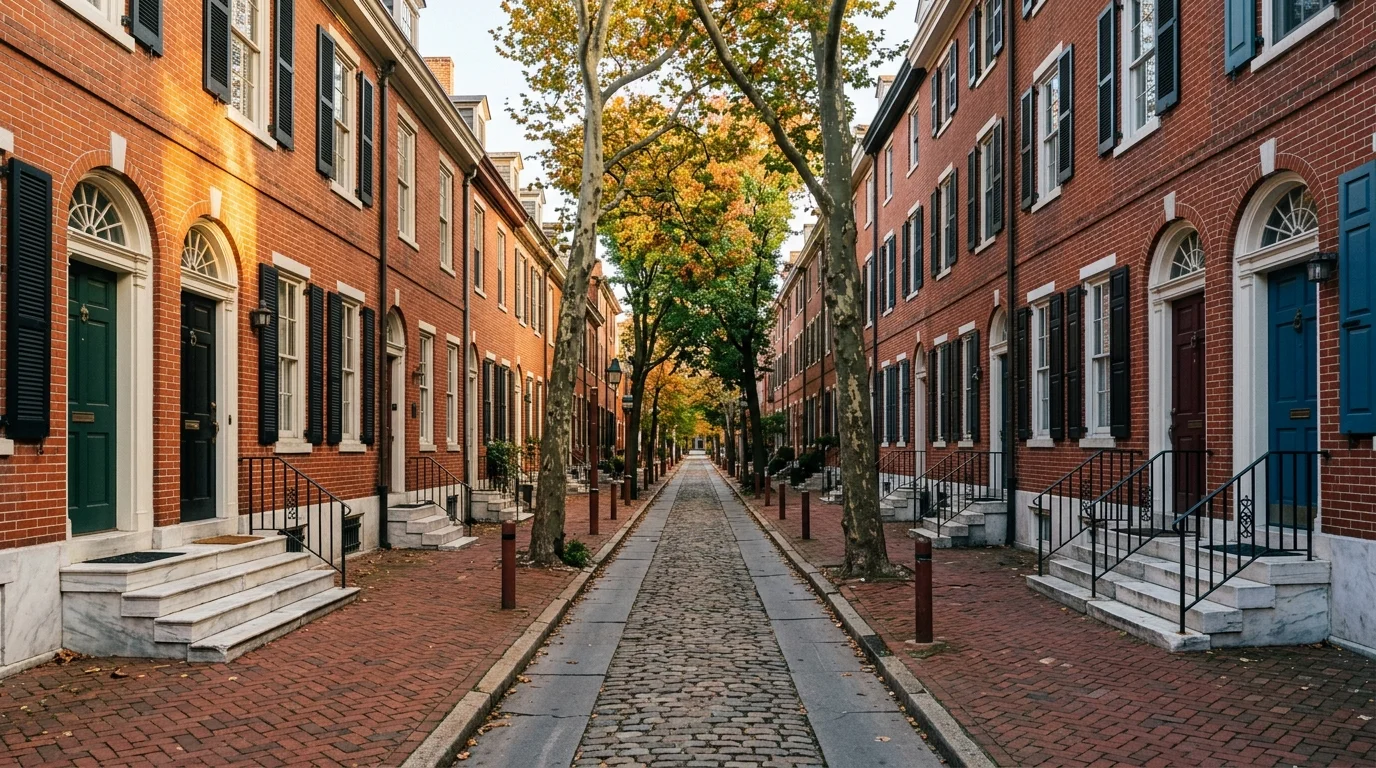
Buying a home in Philadelphia starts with a mortgage pre-approval and ends at a settlement table where the line that surprises buyers most is usually the realty transfer tax: 4.578 percent of the price, 3.578 percent to the City and 1 percent to the Commonwealth, according to the City of Philadelphia. Between those two points, the work is understanding exactly what you are buying: the block, the building, the taxes, the condition and the parking.
I am Naomi Kurzyna, a REALTOR with Compass in Philadelphia. This is the guide I walk my own buyers through, whether they are looking at a trinity rowhome, a twin, a Center City condominium or a co-op.
Buying a home in Philadelphia is about much more than finding the right property. My role is to help you understand the neighborhood, the building, the value, the condition of the property and the entire process, so you can make a confident and informed decision.
Step one: get pre-approved before you seriously shop
One of my first recommendations is to become pre-approved before you start shopping in earnest. A pre-approval tells you what you can borrow, what your monthly payment is likely to be at different prices, and roughly how much cash you will need at closing. It also tells a seller that your offer is real. In a city where a well-priced home on a good block can draw interest quickly, walking in with financing already reviewed puts you in a much stronger position than trying to arrange it after you have found the house.
If you do not already have a lender, I am happy to connect you with local mortgage professionals who understand the Philadelphia market and can walk you through financing options, estimated monthly payments and closing costs. Ask any lender you speak with to include Philadelphia’s transfer tax in the closing cost estimate from the start. It is the line item that surprises buyers most, and a pre-approval built without it can leave you short at the table.
For a first look at payments, the payment calculator on this site is a useful starting point. Treat it as a rough guide, not a replacement for a lender’s written estimate.
What a strong pre-approval conversation covers
- Your down payment and the cash you will need for closing costs on top of it, including your share of the transfer tax.
- For a condominium, the monthly association fee, which a lender will count in your monthly obligations.
- For a co-op, whether the lender finances co-op purchases at all, since not every lender does.
Closing costs for Philadelphia buyers
Philadelphia closing costs are important to understand before you make an offer, not after. I help my buyers anticipate the expenses associated with a purchase, including transfer tax, title costs and other settlement expenses, so there are no unnecessary surprises along the way. The largest and least familiar of those is the transfer tax.
The Philadelphia realty transfer tax
The City of Philadelphia states the current realty transfer tax rate as 3.578 percent (City) plus 1 percent (Commonwealth), for a total of 4.578 percent. For an arm’s-length sale, the City applies that rate to the actual consideration, meaning the sale price plus any assumed debt. The Pennsylvania Department of Revenue confirms the Commonwealth’s portion: a 1 percent realty transfer tax on the value of real estate transferred, collected by county Recorders of Deeds, often together with a local realty transfer tax. In Philadelphia, the tax is paid when the deed is presented for recording with the City’s Department of Records.
To put the rate in scale, here is the City’s own formula applied to a round number. On an illustrative $500,000 purchase with no assumed debt, 4.578 percent is $22,890 in total transfer tax. If that total were split evenly, each side would pay $11,445. Your real figure depends on your price and on the terms of your agreement of sale.
Who pays it: custom, not law
In Philadelphia, the transfer tax is customarily split evenly between the buyer and the seller. That is custom, and it is negotiable in the agreement of sale. The City says so directly: the tax is usually split evenly, but this is not a legal requirement, and the City has the right to collect 100 percent of the tax from either party. The Pennsylvania Department of Revenue states that the grantor and grantee are jointly and severally liable for the Commonwealth tax. That is why the City advises that it is in the buyer’s interest to make sure the tax is paid in full at closing. Read the transfer tax paragraph in your agreement of sale before you sign it.
Title and settlement costs
The rest of a buyer’s closing costs fall into a few groups, and the exact figures come from your lender’s estimate and your title company or settlement agent, not from a rule of thumb.
| Cost | What it is | Who usually pays |
|---|---|---|
| Realty transfer tax | 4.578 percent total in Philadelphia (3.578 percent City, 1 percent Commonwealth), per the City | Customarily split evenly; negotiable in the agreement of sale |
| Title search and title insurance | A search of the public record for liens, judgments and ownership issues, and a policy protecting against covered title defects. A lender will usually require a lender’s policy; an owner’s policy protects you | Set out in your agreement of sale and settlement statement; ask your title company for its quote |
| Settlement and recording | The title company’s settlement services and the City’s fees to record the deed and mortgage. The Department of Records publishes current recording fees | Allocated by the agreement of sale and settlement statement |
| Lender charges | Origination, appraisal, credit report and any points you choose to pay | Buyer, as shown on the lender’s estimate |
| Prepaids and escrows | Homeowners insurance, and property tax reserves if your lender escrows them | Buyer |
| Adjustments | Prorated real estate taxes, and for condominiums, association fees and any capital contribution the documents require | Set out on the settlement statement |
Property taxes, assessments, the Homestead Exemption and abatements
Property taxes require a closer look in Philadelphia. I review the current taxes, the assessed value and any applicable tax abatement or exemption for every property my buyers are serious about. The seller’s current bill is not always the bill you will pay, because exemptions and abatements belong to a particular owner or a particular period of time, and both can change when a home sells.
How the assessment works
The City’s Office of Property Assessment (OPA) determines what every property in Philadelphia is worth, and that assessed value is used to calculate the property’s real estate tax. OPA also handles the abatement and exemption programs that may reduce a bill, and it offers a review and appeal process if an owner disagrees with an assessment. You can look any address up on the City’s Property Search at property.phila.gov. The record shows the market value the City has assigned, the taxable and exempt portions of the land and the improvement, and whether the property currently has a Homestead Exemption.
The Homestead Exemption
According to the City of Philadelphia, if you own your Philadelphia home and live in it as your primary residence, you are eligible for the Homestead Exemption on your Real Estate Tax. The exemption reduces the property’s assessed value by $100,000 for tax purposes. The City states that, starting in 2025, most homeowners save up to $1,399 a year on their Real Estate Tax bill as a result.
A few points from the City’s page matter to a new buyer:
- You are still eligible if you have a mortgage, and even if you are a new homeowner.
- The exemption does not transfer from the seller. As the new owner, you apply for it yourself.
- Once the City accepts your application, you do not reapply unless your deed changes, for example when you refinance or add or remove a co-owner.
- The final deadline to apply is December 1 of each year. The City suggests applying by October 1 to see the benefit reflected on the next bill.
- You can apply online through the Philadelphia Tax Center, by phone on the City’s Homestead Hotline at (215) 686-9200, or by mail. Approval is the City’s decision.
Tax abatements
The City describes a property tax abatement as an exemption of all or part of an improvement from real estate tax for a set number of years, designed to encourage new construction or rehabilitation. OPA administers several types, including a 30-month abatement during residential construction, 10-year abatements for residential rehabilitation, and 10-year abatements for new residential construction. The terms depend on the type of abatement and when it was granted.
For a buyer, an abatement raises three questions: is there one on this property, what type is it, and when does it end. A home with an abatement can carry a low tax bill today and a noticeably higher one after the abatement expires. That deserves an answer before you make an offer.
How to check a Philadelphia property for an abatement or exemption
- Search the address on property.phila.gov. Note the market value and whether any value is shown as exempt land or exempt improvement.
- Look at whether the Homestead Exemption is currently on the record. If it is, it belongs to the current owner, and you will need to apply for your own.
- If a newly built or renovated home shows an exempt improvement value, ask for the abatement type and its start and end dates, and confirm them with the Office of Property Assessment.
Abatement or Homestead, not both
The City states that properties with a 10-year residential tax abatement are not eligible for the Homestead Exemption. An owner can apply for the Homestead Exemption after the abatement expires, or can ask to remove the abatement, but the City notes that once an abatement is removed it cannot be put back on the property. If you are buying an abated home as your primary residence, that is a decision to understand before you settle.
Want a second set of eyes on a specific property?
Send me the address. I will walk you through what I would check first, from the tax record and any abatement to the building and the block.
Contact NaomiThe extra layer for condominiums and co-ops
If you are purchasing a condominium, there is another layer of due diligence. I help my buyers look beyond the individual unit and understand the condominium association: the monthly fees, the reserves, the insurance, any assessments, the rules, the rental and pet policies, parking, and the other factors that can affect both your experience of living there and your ability to resell later.
Every building is different, and those details change. A building’s fee, reserve balance and policies this year are not necessarily what they will be next year. I review the current documents with each buyer. If you are considering a specific building, ask me for its current fees and policies rather than relying on an older listing or a website.
A co-op is a different form of ownership. Instead of a deed to a unit, you generally buy shares in the corporation that owns the building and receive the right to occupy your home, and many co-ops have their own approval process for new buyers. Financing, monthly charges and the rules that govern a sale can all differ from a condominium, so the questions change too.
I cover both in detail in Buying a Condo or Co-op in Center City Philadelphia. If one building in particular is on your list, Living at Waterfront Square shows the kind of building-level questions I work through.
Inspections: rowhomes, new construction and high-rises
Inspections are particularly important in Philadelphia, where we have everything from historic rowhomes to new construction and high-rise condominiums. Each one asks different questions of an inspector.
Rowhomes and twins
An older rowhome or twin shares walls, and often roofing details, with its neighbors. The structure, the masonry, the roof, the sewer line from the house to the street, the electrical service and the plumbing can all be many decades old or partly updated at different times. A general home inspection is the starting point. When the findings call for it, I can connect you with contractors and specialists for additional evaluations of roofs, masonry, plumbing, electrical systems, sewer lines, HVAC systems and other property-specific concerns. A sewer line camera inspection is one of the additional checks I raise often on older homes. Buying a Philadelphia Rowhome goes further into what to look at on this type of home.
New construction
New does not mean inspected. A new home still benefits from an independent inspection, ideally before the walls are closed where the builder allows it and again before settlement. Ask what warranty comes with the home, who stands behind it, and whether the property carries a tax abatement, since that affects both your costs today and your costs later.
High-rise condominiums
In a high-rise, your inspector looks at the unit: its windows, its plumbing and appliances, its heating and cooling equipment and anything else the documents say you own. The roof, facade, elevators and central building systems are generally the association’s responsibility, and their condition shows up in the building’s reserves, budget and any planned assessments rather than in your inspection report.
Parking should never be assumed
Parking is another detail that should never be assumed. Depending on the property, a parking space may be deeded, separately deeded, assigned, licensed or leased, and those arrangements are not interchangeable. I help my buyers verify exactly what is included with a purchase.
- Deeded: the space is conveyed as part of the property you are buying.
- Separately deeded: the space is its own piece of real estate with its own deed, and it needs to be included in the purchase explicitly.
- Assigned: the association assigns a space for your use under the building’s rules, which can change.
- Licensed: you have permission to use a space on stated terms, which may be revocable or tied to fees.
- Leased: you rent the space under a lease, with its own term and cost.
Parking can affect both your daily life and your resale value, so the agreement of sale should say exactly what you are getting.
What to check before you make an offer
Here is the short list I run through with buyers before we write an offer. Most of it takes minutes, and all of it is easier to deal with now than during the inspection period.
| Item | Where to find it | Why it matters |
|---|---|---|
| Pre-approval and cash to close | Your lender’s written pre-approval and estimate | Confirms you can close at this price, including your share of the transfer tax |
| Transfer tax terms | The agreement of sale; the City’s Realty Transfer Tax page | At 4.578 percent total, the split is a significant number to negotiate |
| Assessed value and current taxes | property.phila.gov (Office of Property Assessment) | The seller’s bill may not be your bill |
| Abatement type and end date | property.phila.gov, then the Office of Property Assessment | Taxes can rise when an abatement ends, and it affects Homestead eligibility |
| Homestead Exemption | property.phila.gov; the City’s Homestead Exemption page | You apply as the new owner; the seller’s exemption does not carry over |
| Condominium or co-op documents | The association or co-op, through the seller and listing agent | Fees, reserves, assessments, insurance, rules, and rental and pet policies |
| Parking | The deed, the condominium documents, or the license or lease | Deeded, separately deeded, assigned, licensed and leased spaces are not the same |
| Zoning and historic designation | atlas.phila.gov | Affects what you can change, add or build on the property |
| Flood mapping | FEMA Flood Map Service Center (msc.fema.gov) | Informs insurance cost and lender requirements; a map is not a guarantee either way |
| Comparable sales on the block or in the building | Your agent’s review of recent sales | Philadelphia values change from block to block and unit to unit |
Think about resale from day one
I encourage buyers to think about resale from the beginning. Even if you plan to stay for many years, I look at the property through the eyes of both today’s buyer and a future buyer. Location, layout, natural light, outdoor space, parking, building finances and comparable sales can all influence long-term value and marketability.
Buyers also tend to focus too much on price per square foot. In Philadelphia, value is much more nuanced. Parking, outdoor space, taxes, condo fees, views, floor level, condition, location within a neighborhood and even the particular block can all have a significant effect on what a home is worth. Two homes with the same price per square foot can be very different purchases.
The same thinking runs through the seller side of the market, which I cover in Selling a Home in Philadelphia.
Philadelphia is a block-by-block market
Most importantly, Philadelphia is a neighborhood and often a block-by-block market. Two properties only a few streets apart, or even two condominiums in the same building, can have very different values and considerations. Buyers often think Philadelphia is one market. It isn’t.
Choosing a home is not only about bedrooms, bathrooms and square footage. It is about your life. Can you walk to your favorite restaurant? Where will you walk your dog? How easy is it to get to the airport or 30th Street Station? Can you walk along the river in the morning? Will this location still feel right for you three years from now? Those answers change from one block to the next, and they are the reason I spend time on the ground with buyers rather than relying only on what shows up online.
If you are still deciding where to look, start with the neighborhood guides on this site, such as Society Hill and Washington Square, Queen Village, Bella Vista and the Italian Market, Old City and the Delaware River, Northern Liberties and Fishtown and Rittenhouse and Graduate Hospital, or browse them all on the neighborhoods page. If you are moving here from another city, Moving to Philadelphia from New York or Washington, DC covers what tends to surprise buyers coming from those markets, and What People Get Wrong About Philadelphia Real Estate covers the most common misunderstandings.
From the first showing through settlement and beyond
Throughout the process, I serve as your Philadelphia real estate resource. From neighborhood guidance and property analysis to lenders, inspectors, title professionals, attorneys, contractors and other local resources, I can connect you with the professionals you may need from your first showing through settlement. I work with buyers across price ranges and property types, including renters who are ready to become owners. My own business started that way.
My job is not to talk anyone into buying a home. It is to give you the knowledge, the resources and the confidence to make the right decision for you, and to stay hands-on from the first showing to settlement. My goal is not simply to help you buy a home. It is to make sure you understand what you are buying, feel supported throughout the process, and have a Philadelphia real estate resource long after you receive the keys. You can read more about how I work on the buyers page and in Naomi Kurzyna, Philadelphia REALTOR at Compass.
Frequently asked questions
The City of Philadelphia states the current realty transfer tax rate as 4.578 percent: 3.578 percent to the City and 1 percent to the Commonwealth of Pennsylvania. For an arm’s-length sale it applies to the actual consideration, meaning the sale price plus any assumed debt. On an illustrative $500,000 purchase with no assumed debt, the total tax is $22,890. The tax is paid when the deed is presented for recording.
By custom, the Philadelphia realty transfer tax is split evenly between the buyer and the seller, but that is not a legal requirement and it is negotiable in the agreement of sale. The City of Philadelphia states that it can collect 100 percent of the tax from either party, and the Pennsylvania Department of Revenue states that the grantor and grantee are jointly and severally liable for the Commonwealth tax. The City advises buyers to make sure the tax is paid in full at closing.
The Homestead Exemption is a City of Philadelphia program for owners who live in their Philadelphia home as their primary residence. According to the City, it reduces the property’s assessed value by $100,000 for Real Estate Tax purposes, and starting in 2025 most homeowners save up to $1,399 a year. New owners apply themselves, online through the Philadelphia Tax Center, by phone at (215) 686-9200 or by mail, and the final deadline each year is December 1. Properties with a 10-year residential tax abatement are not eligible while the abatement is in place.
Search the address on the City’s Property Search at property.phila.gov, which shows the market value, the taxable and exempt portions of the land and improvement, and whether a Homestead Exemption is on the property. An exempt improvement value on a newer or renovated home usually signals an abatement. Confirm the abatement type and its end date with the Office of Property Assessment, which administers abatements, before you make an offer.
A Philadelphia buyer typically pays their agreed share of the realty transfer tax, which totals 4.578 percent per the City and is customarily split evenly with the seller, plus title search and title insurance, settlement and recording charges, lender fees, prepaid homeowners insurance and tax escrows, and prorated taxes. Condominium buyers may also see association fee adjustments and any capital contribution the documents require. Ask your lender and title company for a written estimate of total cash to close before you sign an agreement of sale.
Yes. A pre-approval tells you what you can borrow, what your monthly payment is likely to be and how much cash you need at closing, and it shows a seller your offer is real. In Philadelphia, ask the lender to include your share of the 4.578 percent realty transfer tax in the estimate from the start, and for a condominium, to include the monthly association fee.
Related resources
Thinking about buying in Philadelphia?
Whether you are just starting to look or already have an address in mind, I am happy to talk through the neighborhood, the building, the costs and the process with you.
Contact NaomiSources
- City of Philadelphia, Department of Revenue, Realty Transfer Tax, phila.gov (page last updated September 3, 2026; accessed September 29, 2026)
- Pennsylvania Department of Revenue, Realty Transfer Tax, pa.gov (accessed September 29, 2026)
- City of Philadelphia, Department of Revenue, Get the Homestead Exemption, phila.gov (accessed September 29, 2026)
- City of Philadelphia, Office of Property Assessment, Get a property tax abatement, phila.gov (accessed September 29, 2026)
- City of Philadelphia, Office of Property Assessment, department homepage, phila.gov (accessed September 29, 2026)
- City of Philadelphia, Property Search, property.phila.gov (accessed September 29, 2026)
- City of Philadelphia, Department of Records, phila.gov, and atlas.phila.gov (accessed September 29, 2026)
- FEMA Flood Map Service Center, msc.fema.gov (accessed September 29, 2026)
Rates and programs are current as of the dates stated and can change. This guide is general information about buying a home in Philadelphia and is not legal, tax, mortgage or insurance advice. Eligibility for any exemption or abatement is determined by the City of Philadelphia. Confirm anything specific to your purchase or your circumstances with your lender, your title company, an attorney or tax professional, and the City’s offices.
Social Cookies
Social Cookies are used to enable you to share pages and content you find interesting throughout the website through third-party social networking or other websites (including, potentially for advertising purposes related to social networking).